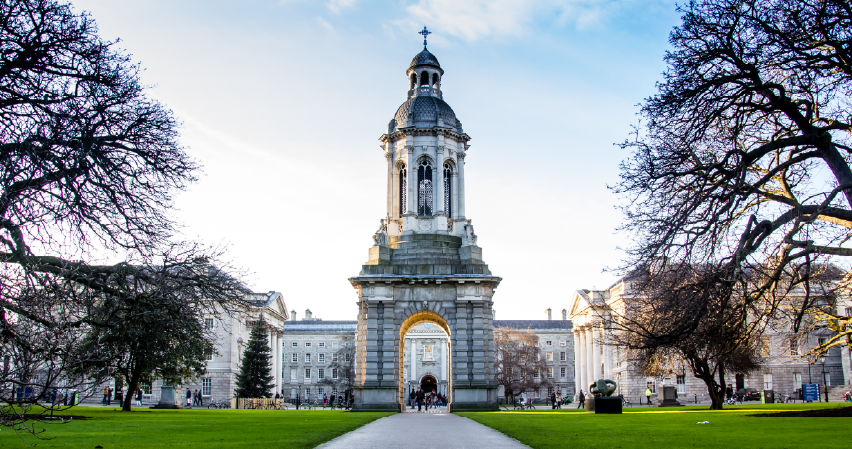
Trinity College Dublin (TCD) – the University of Dublin – is Ireland’s oldest and highest-ranked university. Founded in 1592 by royal charter of Queen Elizabeth I, it is one of the seven ancient universities of Britain and Ireland and the only Irish member of the League of European Research Universities (LERU). Its iconic 47-acre campus sits in the heart of Dublin city centre and is home to the Old Library and the famous Book of Kells.
Trinity College Dublin (TCD) operates through three faculties – Arts, Humanities & Social Sciences; Engineering, Mathematics & Science; and Health Sciences – across 24 schools, offering 400+ programmes to over 20,000 students from 120+ countries. It ranks 75th in the world (QS World University Rankings 2026), No. 1 in Ireland, and in the global top 100 for 22 subjects.
Renowned for research, independent intellectual inquiry, and a distinctive “Trinity Education” model – including a personal Tutor for every undergraduate – Trinity has educated Nobel laureates, world-leading writers, and global leaders. It is also ranked among the world’s best for graduate employability and has been named Europe’s leading university for producing entrepreneurs.
Table of Contents
Key Stats at a Glance
| Parameter | Detail |
|---|---|
| Institution | Trinity College Dublin (TCD) – the University of Dublin (founded 1592) |
| Type | Public research university – Ireland’s oldest; sole college of the University of Dublin |
| Location | College Green, Dublin 2 – a 47-acre campus in the city centre |
| Global ranking | 75th in the world and No. 1 in Ireland (QS World University Rankings 2026); top 100 in 22 subjects |
| Faculties | Arts, Humanities & Social Sciences; Engineering, Mathematics & Science; Health Sciences (24 schools) |
| Students | 20,000+ from 120+ countries; 130,000+ alumni in 140+ countries |
| Programmes | 400+ undergraduate and postgraduate courses |
| Distinctive | Personal Tutor for every undergraduate; only Irish member of LERU; home of the Book of Kells |
| Employability | Top 100 worldwide (QS); No. 1 in Ireland; a leading European university for producing entrepreneurs |
| Medium of instruction | English |
Note: Rankings and figures vary by source and year. Confirm current details on the official Trinity site (tcd.ie).
Programs (Courses & Areas)
Trinity College Dublin (TCD) offers a comprehensive range of programmes across its three faculties:
| Area | Examples |
|---|---|
| Arts, Humanities & Social Sciences | English, history, law, business, drama, film and music, education, and social sciences. |
| Engineering, Maths & Science | Engineering (a five-year integrated programme with a master’s year), computer science, data science, mathematics, physics, and the natural sciences. |
| Health Sciences | Medicine, nursing and midwifery, pharmacy, dentistry, and allied health. |
| Popular with international students | Business, computer science, data science, cybersecurity, and engineering. |
Many degrees offer joint honours, optional modules, study abroad, and internships. A Trinity International Foundation Programme prepares students for direct undergraduate entry. See the official site for the full course list.

Fees (International Students)
As Ireland’s leading university, Trinity’s non-EU fees are premium and vary widely by programme. Indicative ranges are below; health-sciences programmes such as medicine are at the very top end.
| Level (non-EU) | Indicative Tuition / year |
|---|---|
| Undergraduate | ~€22,000–€30,000+ (medicine and some health sciences higher) |
| Postgraduate / taught master’s | ~€16,000–€37,000+ (varies by programme) |
A deposit is payable to accept your offer. Dublin living costs are high – budget roughly €13,000–€18,000 per year. Always confirm the exact tuition for your course and year on the official fees page.
Admission Process & Timeline
International (non-EU) students apply directly to Trinity online. The general steps are:
- Choose your course and check its specific entry requirements on the official Trinity website.
- Apply through the my.tcd.ie portal (the “Non-EU Application” link on your course page) and pay the ~€55 application fee per course (Irish/EU undergraduates apply via the CAO).
- Upload transcripts, certificates, English-language evidence, and any supporting documents; students who do not meet direct entry can apply via the International Foundation Programme.
- Receive your offer (conditional or unconditional) – admission is competitive, so results well above the minimum strengthen your application.
- Accept your offer, pay the deposit, and arrange your study visa and accommodation.
Trinity has one primary intake – September – for most full-time degrees. There is a priority deadline (around 1 February) with rolling admissions until around 30 June; high-demand programmes fill early, so apply by early May where possible.
Curious about other top universities in Ireland? Explore our complete Study in Ireland guide to compare options.
Scholarships & Financial Planning
Trinity College Dublin (TCD) offers a range of awards to international students:
- Global Excellence Scholarships — awards (up to full tuition) for outstanding non-EU applicants, often awarded automatically or via a post-offer application.
- India-specific undergraduate scholarships — merit awards (reported in the region of €3,000–€5,000 in the first year) for strong Indian applicants.
- Merit, country, and subject awards — a variety of additional scholarships across faculties.
- Government of Ireland International Education Scholarships — competitive national awards open to international students.
Fees are premium, so combine scholarships with savings and (for Indian students) education loans. Tuition can usually be paid in instalments. Check the official Trinity scholarships pages for current awards and deadlines.
Admission / Entry Requirements (Academic & English)
- Undergraduate: A recognised school-leaving qualification (such as Class 12) meeting Trinity’s requirements – competitive programmes require results well above the minimum; an International Foundation Programme offers an alternative pathway.
- Postgraduate: A recognised bachelor’s degree in a relevant field with a strong academic record (course-specific minimums apply).
- English proficiency: Typically around IELTS 6.5 overall with no band below 6.0 (some programmes require higher); TOEFL, PTE, and Duolingo are also accepted.
Requirements vary by programme — always check the individual course page on the official site.
Notable Alumni
Since 1592, Trinity College Dublin (TCD) has educated extraordinary thinkers, writers, scientists, and leaders. Notable graduates include:
| Name | Known for |
|---|---|
| Samuel Beckett | Nobel Prize-winning playwright and author (“Waiting for Godot”). |
| Oscar Wilde | Celebrated playwright, poet, and author. |
| Mary Robinson | First female President of Ireland and former UN High Commissioner for Human Rights. |
| Edmund Burke | Influential 18th-century statesman and political philosopher. |
| Ernest Walton | Nobel laureate physicist who first split the atom. |
| Paul Mescal | Academy Award-nominated actor. |
Trinity’s wider alumni – more than 130,000 graduates across 140+ countries – include further Nobel laureates, scientists, writers, and leaders in business, law, medicine, and public life.

Campus Life
Trinity’s historic campus sits right in the heart of Dublin – a beautiful blend of classic and modern architecture that is also one of the city’s best-loved landmarks. Student life is exceptionally rich, with academic and personal support woven through the Trinity Education model.
Highlights of the student experience include:
- Around 120+ student societies and many sports clubs – from debating, drama, and music to coding, cycling, and an active international and Indian student community.
- A personal Tutor for every undergraduate, plus learning support, peer mentoring, counselling, and careers advice.
- World-class facilities, including the largest library in Ireland and modern sports and wellness centres.
- A central city-centre location at the hub of Dublin’s culture, technology, and business life.
On-campus accommodation (including Trinity Hall) is limited; many students live in private rentals across Dublin – arrange housing early, as the city is competitive.
Careers & Employability
A Trinity degree is highly valued by employers worldwide:
- Trinity ranks among the world’s top 100 for graduate employability (QS) and No. 1 in Ireland for employer reputation.
- Its city-centre location places students at the heart of Ireland’s technology and business hub, with strong recruitment for internships and graduate roles.
- A leading European university for producing entrepreneurs, with incubation programmes supporting student-led start-ups.
- Ireland’s Third Level Graduate Programme lets eligible non-EU graduates stay to seek work – typically up to 1 year after a Level 8 (honours) degree and up to 2 years after a Level 9 (master’s), subject to current rules.
Post-study work entitlements are set by Irish immigration policy and can change – verify the latest rules on official sources.

FAQs
On College Green in the heart of Dublin city centre - a historic 47-acre campus that is also one of the city's most famous landmarks.
Trinity College Dublin (TCD) is ranked 75th in the world and No. 1 in Ireland (QS World University Rankings 2026), and is in the global top 100 for 22 subjects.
Over 400 programmes across three faculties - Arts, Humanities & Social Sciences; Engineering, Mathematics & Science; and Health Sciences - including popular options like business, computer science, data science, and engineering.
Non-EU undergraduate tuition is indicatively around €22,000–€30,000+ per year (medicine higher), and taught master's around €16,000–€37,000+, plus Dublin living costs of roughly €13,000–€18,000. Confirm per course.
Typically around IELTS 6.5 overall with no band below 6.0 (some programmes require higher); TOEFL, PTE, and Duolingo are also accepted.
Non-EU students apply online via the my.tcd.ie portal with a ~€55 fee per course; an International Foundation Programme is available as a pathway.
Trinity College Dublin (TCD) has one primary intake - September - with a priority deadline around 1 February and rolling admissions until around 30 June.
Yes - including Global Excellence Scholarships (up to full tuition), India-specific undergraduate awards, and Government of Ireland scholarships.
Ireland's Third Level Graduate Programme lets eligible non-EU graduates stay to seek work - typically up to 1 year after a Level 8 degree and 2 years after a master's - subject to current rules.
Trinity College Dublin (TCD) offers a world-top-100, historic, research-intensive education in the heart of Dublin, with a personal-Tutor model, outstanding facilities, and excellent graduate employability.
Ireland Universities
- Trinity College Dublin (TCD)
- University College Dublin (UCD)
- University of Galway
- University College Cork (UCC)
- National College of Ireland (NCI)
- Dublin City University (DCU)
- University of Limerick (UL)
- Technological University of the Shannon
- Dublin Business School (DBS)
- Griffith College Dublin
- Technological University Dublin
- Munster Technological University (MTU)
- Atlantic Technological University (ATU)
- Dundalk Institute of Technology (DkIT)
- National College of Art and Design
- Institute of Art, Design & Technology
- Mary Immaculate College (MIC)
- Maynooth University
- Royal College of Surgeons (RCSI)
- South East Technological University
- Shannon College of Hotel Management
- Independent College Dublin
- ICD Business School
- Dorset College Dublin
- CCT College Dublin
- American College Dublin
Ireland Universities


-
National College of IrelandApp Fee Waiver
-
Dublin City UniversityApp Fee Waiver
-
Dublin Business SchoolApp Fee Waiver
-
University College DublinApp Fee Waiver*€70 for 4 programs still applicable.
-
Dundalk Institute of TechnologyApp Fee Waiver
-
South East Technological University, CarlowApp Fee Waiver
-
Griffith College – Dublin, Cork & LimerickApp Fee Waiver
-
Munster Technological University (CIT)App Fee Waiver
-
Technological University Shannon (Athlone & Limerick)App Fee Waiver