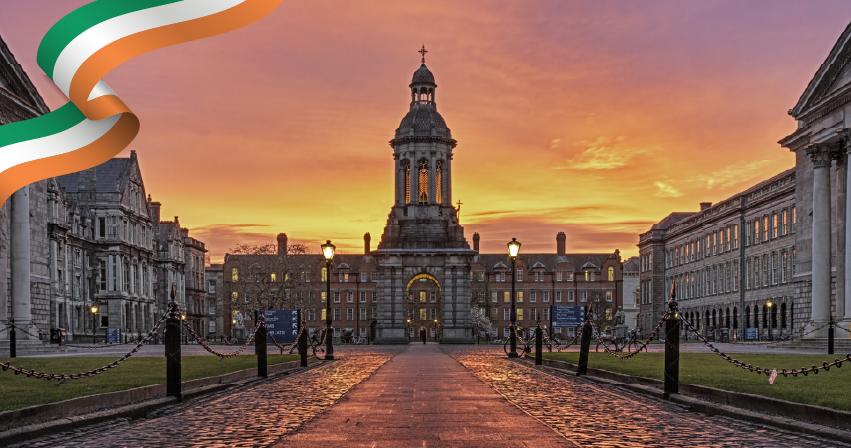
Why Study In Ireland?
Ireland has a rich tradition of research and innovation. Here’s why it stands out as a top study destination:
- Sustained government investment in education has made Ireland one of the highest-ranking countries for student participation globally.
- Irish universities and courses are internationally recognised, with all programmes for international students closely monitored by educational authorities for quality.
- International students can work up to 20 hours per week during term time and 40 hours per week during academic holidays.
- Over 100 multinational companies operate from Ireland, offering plentiful career opportunities across industries.
- More than 300 leading pharmaceutical and medical device companies are based across the country.
- Ireland is the world’s second largest exporter of software, reflecting its strength in technology and innovation.
- Strong career opportunities exist for students in engineering, financial services, software development, IT, and food and agriculture.
- Dublin ranks among the top 50 cities in the world to start a business.
- The Irish government offers unique programmes, immigration pathways, and start-up funding to support entrepreneurs.
- Ireland offers a vibrant social life, stunning countryside, and culturally rich cities like Dublin — making it a well-rounded destination for international students.
Ireland is located at the westernmost edge of Europe. It boasts one of the stable, yet fastest-growing economies in the world. The country is known for its world-class education system, and universities globally collaborate with some of the best study institutions and international companies. This gives students the opportunity to build their careers in different parts of the world after successfully graduating from a university in Ireland. In addition to the education system, the students can enjoy the greenery, fascinating countryside, and travel through vibrant and culturally sophisticated cities like Dublin.
1. RANKED 3RD MOST PEACEFUL COUNTRY
Ireland has become one of the most popular study-abroad destinations for international students. The country embraces cultural diversity and is widely regarded as a safe, open society. According to the Global Peace Index 2024, Ireland ranks 3rd among the most peaceful countries in the world.
2. WARM TOWARDS FOREIGN STUDENTS
Ireland has seen a steady rise in international student enrolments, largely due to the warmth and hospitality that residents extend to newcomers. Despite an increasingly diverse population, Irish communities have remained welcoming and inclusive.
For many international students, the fear of discrimination or feeling out of place is a real concern. Ireland addresses this from the outset — locals are known for being friendly, approachable, and genuinely helpful to new arrivals, making the transition to life abroad much smoother.
3. OFFERS STAY-BACK VISAS
Upon graduation, Ireland actively encourages international students to remain in the country to work and contribute to the economy. Students who complete a Level 8 or above qualification from a recognised Irish institution are eligible to apply for a stay-back visa.
This is a significant advantage, as work experience gained in Ireland — a globally recognised education and business hub — adds considerable value to any professional profile.
4. FOCUSES ON INDEPENDENT LEARNING
Irish universities follow a distinctive approach to education that emphasises independent learning. Students are encouraged to identify challenges, think critically, and arrive at solutions on their own. The expression of individual opinions is actively encouraged in class, fostering more meaningful and engaging academic discussions.
While this style of learning may take some adjustment initially, support from peers and experienced tutors makes the transition manageable — and the skills developed through this process prove invaluable in professional life.
5. GET RECRUITED IN TOP BRANDS
Ireland is home to the European or global headquarters of many of the world’s leading companies. Gaining work experience with these organisations exposes students to industry best practices and helps build a strong professional foundation. Top employers based in Ireland include Accenture, Google, Meta, Bank of Ireland, and Kingspan Group, among others.
Education System in Ireland
In Ireland, the education system is distinguished into three levels:
- First Level Education – Primary
- Second Level Education – Post-Primary
- Third-level Education – Higher Education
In this, the third-level education comprises universities, institutes of technology, private colleges, and colleges of education. All these educational institutes are funded by the government.
| Level | Type | Details |
|---|
| First Level | Primary Education | Foundation schooling for young children |
| Second Level | Post-Primary Education | Secondary schooling leading to the Leaving Certificate |
| Third Level | Higher Education | Universities, Institutes of Technology, Private Colleges, Colleges of Education — all government funded |
Third-Level Degree Programs
| Degree | Duration | Mode | Notes |
|---|
| Bachelor’s | 3 years | Full-time / Part-time | Undergraduate level |
| Master’s | 1 year (taught) / 2 years (research) | Full-time | Research programs may take longer |
| Doctorate (PhD) | 3–4 years | Structured or Traditional | Structured programs include additional evaluation and training elements |
Note: The Turing Scheme allows students to study abroad and secure overseas placements. This is only available if your university has a formal agreement with a partnering foreign institution.
The universities offer degree programs at Bachelor’s, Master’s, and Doctorate Levels.
1. The bachelor’s programs or undergraduate programs can be pursued part-time and full-time. Generally, full-time bachelor’s courses last three years.
2. Irish master programs take a year to complete, however, some master programs by research may last two years.
3. Irish doctorate programs may last three or four years. You can enroll for structured and traditional programs. The structured programs are similar to traditional programs, but have an additional element of evaluation and training.
Note: Student exchanges through the Turing Scheme is gaining popularity. This allows students to study abroad and secure overseas placements. However, students can seek advantage of this scheme, only if their university has a formal agreement with any foreign university.
Types of Educational Institutes
| Institute Type | Description |
|---|
| Universities | 7 autonomous, self-governing institutions ranked in the top 3% of universities worldwide |
| Institutes of Technology | 14 institutes offering education and training in business, science, engineering, linguistics, and music at certificate, diploma, and degree levels |
| Private Colleges | Specialist education in areas like medicine, law, business, and agriculture |
| Colleges of Education | Specialised training for students pursuing teaching careers |
| Percentage | Classification | International Equivalent |
|---|
| 70% and above | First Class Honours | A – Excellent |
| 60% – 69% | Upper Second Class Honours | B – Very Good |
| 50% – 59% | Lower Second Class Honours | C – Good |
| 45% – 49% | Third Class Honours | D – Satisfactory |
| 40% – 44% | Compensating Fail (Minimum Pass) | E – Sufficient |
The following examples of grading across universities will help you understand it better.
Dublin City University (DCU)
| Percentage of Grade | Degree Classification | Description |
|---|
| 70% – 100% | First Class Honours | Excellent, exemplary, thorough, clear, and free of errors. |
| 60% – 69% | Second Class Honours, First Division | Good, well-structured, only minor omissions or errors. |
| 50% – 59% | Second Class Honours, Second Division | Fair, satisfactory content, some less developed areas and errors. |
| 40% – 49% | Third Class Honours | Adequate or barely adequate, substantial errors and/or omissions. |
| Less than 40% | Insufficient – Does not meet minimum expected standards | Fail |
University College Cork (UCC)
| Percentage of Grade | Degree Classification | Description |
|---|
| 70% – 100% | First Class Honours | Excellent, exemplary, thorough, clear, and free of errors. |
| 60% – 69% | Second Class Honours, Grade 1 | Good, well-structured, only minor omissions or errors. |
| 50% – 59% | Second Class Honours, Grade 2 | Fair, satisfactory content, some less developed areas and errors. |
| 45% – 49% | Third Class Honours | Adequate or barely adequate, substantial errors and/or omissions. |
| 40% – 44% | Poor; Meets Minimum Expectations | Pass |
| Below 40% | Insufficient – Does Not Meet Minimum Standards | Fail |
Grading System in Ireland
The grading system in Ireland varies across institutions. Most institutes follow a unique grading system. The minimum score for passing in Ireland is 40%. The following is a common grading system followed by Irish universities.
| Percentage of Grade | Description | International Scale |
|---|
| 70% or above | First Class Honours | A (Excellent) |
| 69% – 60% | Upper Second Class Honours | B (Very good, with few errors) |
| 59% – 50% | Lower Second Class Honours | C (Good, with some errors) |
| 40% – 49% | Third Class Honours | D (Satisfactory, with many errors) |
| 44% – 40% | Compensating Fail | E (Sufficient) |
The following examples of grading across universities will help you understand it better.
Dublin City University (DCU)
| Percentage of Grade | Description | International Scale |
|---|
| 70% – 100% | First Class Honours | Excellent |
| 60% – 69% | Second Class Honour | Good |
| 50% – 59% | Second Class Honours | Satisfactory |
| 40% – 49% | Third Class Honours | Adequate |
| Less than 40% | Not Satisfactory | Fail |
University College Cork (UCC)
| Percentage of Grade | Degree Classification | Description |
|---|
| 70% – 100% | First Class Honours | Excellent |
| 60% – 69% | Second Class Honour | Good |
| 50 – 59% | Second Class Honours | Satisfactory |
| 45 – 49% | Third Class Honours | Adequate |
| 40 – 44% | Poor | Pass |
| Less than 40% | Not Satisfactory | Fail |
National University of Ireland
The following examples of grading across universities will help you understand it better.
| Percentage of Grade | Degree Classification | Grade |
|---|
| 70% – 100% | Excellent | A |
| 60% – 69% | Very Good | B |
| 50 – 59% | Good | C |
| 40 – 49% | Poor | D |
| Less than 40% | Fail | F |
Top Courses To Pursue in Ireland for Indian Students
Ireland is popular for offering international students a wider range of course options. However, their course choices have grown in demand over the years as all courses designed in Ireland follow an independent learning approach. This means students will learn how to identify issues and find valuable solutions. Following this course format has made multiple Irish graduates valuable assets to prestigious organizations globally.
Pursuing a course in Ireland has multiple benefits, such as:
- When studying any course in Ireland, students will implement a hybrid learning method. This includes the blend of practical training and academic learning simultaneously.
- Course curriculums in Ireland are updated regularly to meet the current job market needs. To improve the quality, all courses are monitored routinely by the Irish educational authorities.
- Courses offered in Ireland cover only those concepts and subtopics that the current job market wants graduates to be equipped with.
- All course structures in Ireland are set-up with the support of industry experts who know what the current and futuristic market needs are.
In Ireland, you can access various kinds of courses which will match any student’s academic interests. However, over the years, there has been a demand for certain courses due to the evolving growth of particular industries. Here is an overview:
1. ENGINEERING
- Top courses to pursue: Biomedical Engineering, Civil Engineering, Mechanical Engineering are popular examples.
- In-Demand course: Biomedical/Civil Engineering (Engineer Ireland stated, in 2024, 67% of engineering employers will be recruiting potential engineers).
- Top Universities: University College Dublin, University of Galway, and Trinity College Dublin.
2. TECHNOLOGY
- Top courses to pursue: Computing, Information Technology, Data Science are popular examples.
- In-Demand course: Big Data/Data Analytics (The World Economic Forum stated the data analytics sector is projected to grow at 40% yearly).
- Top Universities: Dublin Institute of Technology, University College Dublin, and Trinity College Dublin.
3. FINANCIAL SERVICES
- Top courses to pursue: Finance, Financial Risk Management, Business Analytics are popular examples.
- In-Demand course: Business Analytics (Reuters stated, by 2026, the government will add 5,000 more employment opportunities in fintech, sustainable finance and digital financial services).
- Top Universities: University College Dublin, Trinity College Dublin and University College Cork.
4. PHARMACEUTICAL
- Top courses to pursue: Industrial Pharmaceutical, Pharmaceutical and Drug Formulation, Pharmaceutical Science are popular examples.
- In-Demand course: Pharmaceutical Science (Irish Pharmaceutical Healthcare Association states, Ireland caters to over 120 overseas pharmaceutical plants, which includes 9 out of 10 most prominent and reputed pharmaceutical companies).
- Top Universities: University College Dublin, Trinity College Dublin and University College Cork.
5. LIFE SCIENCES
- Top courses to pursue: Biology, Biotechnology, Digital Transformation are popular examples.
- In-Demand course: Biomaterial Science (The Association of the British Pharmaceutical Industry stated, the Northern Ireland’s life science sector is worth £2.4 billion and supports over 19,500 jobs directly and 15,000 jobs indirectly (provides jobs spread across the economy).
- Top Universities: University College Dublin, University of Galway and University College Cork
Apart from the above, there are also several other courses which you can pursue in Ireland, such as:
| Course | Course |
|---|
| Artificial Intelligence | Big Data / Data Science |
| Business Analytics | Cloud Computing |
| Construction | Cyber Security |
| Data Analytics | Pharmaceutical Sciences |
| Investment Banking and Finance | Software Engineering |
All courses offered by leading Irish universities have been created to ensure students are equipped with the required skills to ace their career goals. Due to this, multiple graduates find their dream job and embark on a new journey to impact their chosen industry.
Popular Universities to Study in Ireland
The following universities feature in the list of QS World University Rankings:
Popular Universities in Ireland that Do Not Require IELTS
1. University of Galway
Alternative Exam Scores Accepted by the University of Galway:
- Cambridge C1 Advanced (CAE)
- Cambridge C2 Advanced (CPE)
- TOEFL iBT / TOEFL iBT Home Edition
- Pearson PTE
- Duolingo
2. University College Cork
Alternative Exam Scores Accepted by the University College Cork:
- Cambridge C2 Proficiency
- Cambridge C1 Advanced
- Cambridge B2 First
- Duolingo English Test (DET)
- LanguageCert IESOL
- LinguaSkill General
- Oxford Test of English
- Pearson PTE
- UCC English Language Centre
3. Royal College of Surgeons in Ireland
Alternative Exam Scores Accepted by the Royal College of Surgeons in Ireland:
- Cambridge CAE & CPE
- TOEIC
- TOEFL Paper
- TOEFL CBT & IBT
- Pearson PTE Academic
4. University College Dublin
Alternative Exam Scores Accepted by University College Dublin:
- Cambridge Examinations – Proficiency Certificate (Grade C: CEFR Level C1 or C2)
- Advanced Certificate (Grade C: CEFR Level C1 or C2)
- First Certificate (Grade A: CEFR Level C1)
- UCLES – English at Grade C or above
- English Test for Academic & Professional Purposes (ETAPP)
- Pearson English Language Test (Academic)
- Trinity ISE
- Duolingo English Test (DET)
- Oxford Test of English
- LanguageCert ESOL
5. University of Limerick
Alternative Exam Scores Accepted by the University of Limerick:
- LanguageCert ESOL
- Duolingo English Test (DET)
- English Test for Academic and Professional Purposes (ETAPP)
- GCE O Level English Language / GCSE English Language
- University of Cambridge ESOL
- Pearson Test of English (Academic)
Popular Cost-Effective Universities in Ireland
Studying in Ireland is generally more affordable compared to countries like the US and the UK. The average tuition fees range between €10,000 and €35,000 per year for bachelor’s, master’s, and PhD programs in public universities.
However, several universities offer high-quality education at relatively lower costs, typically between €10,000 and €25,000 per year.
Affordable Universities in Ireland
- Trinity College Dublin
- University of Limerick
- Dublin City University
- National University of Ireland, which includes:
- University College Dublin
- University College Cork
- University of Galway
- Maynooth University
These universities are known for offering good academic standards, global recognition, and relatively lower tuition fees, making them popular choices among international students.
Admission Process to Study in Ireland for Indian Students
The admission process in Ireland varies by university and course, but the general steps are as follows:
- Choose your course based on your academic background and career goals.
- Shortlist universities and colleges offering the program.
- Compare course structure, fees, and entry requirements.
- Check eligibility criteria on official university websites.
- Prepare required documents (SOP, LORs, transcripts, resume).
- Take English proficiency tests such as IELTS, TOEFL, or equivalent.
- Apply:
- Undergraduate: via Central Applications Office
- Postgraduate: directly through university websites
- Pay the application fee (if required).
- Receive and accept the offer; pay the deposit to confirm your seat.
- Apply for the student visa after accepting the offer.
Arrange accommodation and travel for Ireland.
Eligibility Criteria and Application Requirements
The admission requirements to study in Ireland vary across universities, but the general criteria are as follows:
Bachelor’s Degree
- Students should have 65%–75% or above in high school (varies by course and university)
- Required documents:
- Applications are submitted through the Central Applications Office
- Some students may need a foundation program depending on eligibility
Master’s Degree
- Students should have 55%–70% or above in a bachelor’s degree (depends on university)
- A relevant undergraduate background is usually required
- Required documents:
- Academic transcripts and degree certificate
- Statement of Purpose (SOP)
- 1–2 Letters of Recommendation (academic/professional)
- English language proficiency test scores
- Resume/CV
- Some programs may additionally require:
- Work experience
- Portfolio (for specific fields)
English Language Requirements
- IELTS: 6.0 – 6.5 overall
- TOEFL: 80 – 90+
Intakes in Ireland
Irish universities primarily offer two intakes: Fall (Autumn) and Spring.
Intakes In Ireland
Irish universities follow Spring and Autumn (Fall) Intakes. Let’s look at the timeline of the intake season.
Fall Intake (Primary Intake)
- Starts: August – September
- Most popular intake with maximum course availability
Recommended Timeline:
- Nov – Jan (previous year): Shortlist courses and universities
- Dec – Feb: Take IELTS/TOEFL (and GRE/GMAT if required)
- Jan – March: Apply to universities
- Feb – May: Receive offers (rolling basis)
- April – June: Accept offer, pay deposit
- May – July: Apply for visa and education loan
- Aug – Sept: Travel to Ireland
Spring Intake (Secondary Intake)
- Starts: January – February
- Limited courses and universities available
Recommended Timeline:
- June – July (previous year): Shortlist courses
- July – Sept: Take IELTS/TOEFL
- Aug – Oct: Apply to universities
- Sept – Nov: Receive offers
- Oct – Dec: Apply for visa and arrange finances
- Jan – Feb: Travel to Ireland
Cost of Education in Ireland
Here we have included the average annual cost of education in EUR (€). Actual values may differ across cities and universities in Ireland.
| Types of Expenses (Annual) | EUR (€) |
|---|
| Tuition Fees | Undergraduate: €12,000 – €28,000 per year
Postgraduate: €12,000 – €25,000 per year
(€30k+ only for premium courses like MBA/Medicine in universities such as Trinity College Dublin or University College Dublin) |
| Accommodation | On-campus: €600 – €1,200/month
Shared apartment: €500 – €900/month
Private apartment: €900 – €1,500+/month |
| Living Expenses | €800 – €1,200/month
(Higher in Dublin, lower in cities like Limerick or Galway) |
| Medical Health Insurance | €150 – €300 per year |
Irish Student VISA
Any international student wishing to study in Ireland must possess one of the following visas:
- C Type Study VISA: This VISA is issued for any program or course that lasts for less than 3 months.
- D Type Study VISA: This VISA is issued for any program or course that lasts longer than 3 months.
How to Apply for Irish Student VISA
- Apply online by filling out an online application form on AVATS.
- Download the completed application form, print and sign it for physical submission.
- Arrange a VISA appointment with VISA Facilitation Service (VFS).
- Pay your VISA fee while booking the appointment or via bank draft, including verification charges.
- Appear for the appointment at the VFS office with all required documents.
- Wait for the VISA outcome, which generally takes around 8 weeks to process.
Documents Required for Irish Student VISA
- Previous Passport (Old & New)
- Statement of Purpose (Visa SOP)
- Evidence of Scholarship (if applicable)
- Unconditional Offer Letter from a Recognised University/College
- Evidence of Sufficient Funds (as per guidelines – approx. €16,000–€18,000 depending on location)
- Evidence of Academic Ability (10th, 12th, Bachelor’s, etc.)
- Evidence of Paid Course Fees (Deposit / Tuition Fee Receipt)
- Financial Documents (Bank Statements, Education Loan, CA Statement, etc.)
- Evidence of Private Medical Insurance
- Evidence of English Language Proficiency
- Accommodation Confirmation (if available)
- Police Clearance Certificate (PCC)
- Visa Cover Letter
- Visa Application Summary Sheet
Exams to Study in Ireland for Indian Students
Language Proficiency Test Requirements
Since English is the primary medium of instruction in Ireland, international students must demonstrate English language proficiency. The most commonly accepted tests for admission to bachelor’s and master’s programs include:
- IELTS (International English Language Testing System): Widely accepted; typical requirement is 6.0 – 6.5 overall
- TOEFL iBT (Test of English as a Foreign Language): Usually requires a score of 80 – 90+
- PTE Academic (Pearson Test of English): Generally accepted with scores around 58 – 63+
- Cambridge English Qualifications (C1 Advanced / C2 Proficiency): Accepted by many universities as proof of advanced English skills
Standardized Test Requirements
GRE and GMAT are generally not required for studying in Ireland. However, certain universities such as Trinity College Dublin may ask for GMAT scores for MBA or specific business-related programs. It is always recommended to check the official university website for course-specific requirements.
Undergraduate Applications
Applications for undergraduate programs in Ireland are processed through the Central Applications Office.
The CAO collects applications and forwards them to universities, which then evaluate candidates and issue offers accordingly.
Government and Non-Government Scholarships to Study in Ireland for Indian Students
Government Scholarships
Government of Ireland International Education Scholarships (GOI-IES):
This scholarship is funded by the Irish Government and managed by the Higher Education Authority. It is mainly available for postgraduate (Master’s and PhD) students. The benefits include a €10,000 stipend for one year along with a full tuition fee waiver. It is highly competitive and awarded to academically strong students.
Government of Ireland Postgraduate Scholarship Programme:
Funded by the Department of Education and managed by the Irish Research Council, this scholarship is available for research-based Master’s and PhD programs. It provides a €19,000 annual stipend, tuition fee support up to €5,750, and research expenses of around €3,250 per year.
Non-Government Scholarships
Walsh Fellowship:
Offered by Teagasc, this scholarship is available for MSc and PhD programs, mainly in agriculture and related fields. It offers an annual stipend of around €22,000.
Central Bank of Ireland Undergraduate Scholarship:
Offered by Central Bank of Ireland, this is a work-study opportunity for students interested in finance, accounting, and business. It includes a salary of around €29,500 per year, along with paid leave and educational support.
University-Specific Scholarships
- University of Galway
- Maynooth University
- Trinity College Dublin
- University College Cork
- Technological University Dublin
These scholarships are usually merit-based and may offer partial tuition fee waivers (typically €2,000 – €5,000).
Post Study Work Visa in Ireland for Indian Students
Students from non-EU/EEA countries can stay back in Ireland after completing their studies under the Third Level Graduate Programme (Stamp 1G). This allows graduates to remain in the country and work full-time while seeking long-term employment opportunities.
Eligibility Criteria
To qualify for this scheme, students must:
- Have completed a recognized degree (Level 8 or above) from an Irish institution
- Hold a valid Stamp 2 student immigration permission
- Not exceed the 7-year limit as a non-EEA student in Ireland
- Comply with immigration rules and maintain good character
| Level of Education | Post Study Work Permit Duration |
|---|
| Level 10 – Doctoral Degree | 24 months |
| Level 9 – PG Diploma / Master’s Degree | 24 months |
| Level 8 – Honors Bachelor’s Degree | 12 months |
Work Rights
Under this scheme, graduates are allowed to work full-time (up to 40 hours per week) without requiring an additional work permit.
Work Permits After Post-Study Period: To continue working in Ireland after the post-study period, graduates can apply for the following permits:
General Employment Permit: Requires a valid job offer from an eligible employer. The minimum salary requirement is typically €34,000 or above. The permit is issued for 2 years and can be renewed, leading to long-term residency.
Critical Skills Employment Permit: Applicable for high-demand occupations listed by the Irish government. The minimum salary requirement is €38,000 for select roles and €64,000 for other eligible roles. A minimum 2-year job contract is required, and it provides a faster pathway to permanent residency.
On-Campus and Off-Campus Jobs in Ireland
International students in Ireland are allowed to work part-time during their studies under student visa regulations.
- Students can work up to 20 hours per week during academic sessions
- Students can work up to 40 hours per week during official holidays (June–September and mid-December to mid-January)
Off-Campus Jobs:
Students can also work off-campus in part-time roles by applying through job portals or local opportunities. Common roles include:
- Retail / shop assistants
- Sales associates
- Customer service executives
- Cafeteria / restaurant staff
- Barista (off-campus cafés)
- Tutors / online tutors
- Healthcare assistants (may require qualifications)
- Community support workers
- Warehouse operatives
- Delivery or logistics assistants
Popular Career Prospects for International Students in Ireland
Ireland offers strong career opportunities for international students, especially in high-demand sectors. Some of the most popular career fields include:
- Information Technology (IT): Software Developer, Data Analyst, Cybersecurity Specialist
- Finance & Accounting: Financial Analyst, Auditor, Investment Banking roles
- Pharmaceutical & Life Sciences: Research Scientist, Quality Analyst
- Business & Management: Business Analyst, Marketing Executive, HR roles
- Engineering: Civil, Mechanical, and Electrical Engineering roles
- Healthcare: Nurses, Healthcare Assistants (subject to qualifications)
| Level of Education | Post Study Work Permit Duration |
|---|
| Level 10 – Doctoral Degree | 24 Months |
| Level 9 – PG Diploma / Master’s Degree | 24 Months |
| Level 8 – Honors Bachelor’s Degree | 12 Months |
| Level 7 – Ordinary Bachelor’s Degree | 6 Months |