
The TOEFL exam is a leading English test for students planning to study abroad. It measures reading, listening, speaking, and writing skills. Over 160 countries, including the USA, UK, Canada, and Australia, accept TOEFL iBT scores. Students can take it at a test center or online with the TOEFL iBT Home Edition.
The TOEFL Exam 2026 is redesigned to be shorter and easier. ETS replaced the 0–120 scoring with a 1–6 scale. Reading passages are shorter, and new tasks are added in Speaking (“Listen and Repeat”) and Writing (“Build a Sentence”). This makes the test quicker and simpler to complete.
With its global recognition and updated format, TOEFL helps students show English proficiency confidently. Collegepond experts provide guidance for high scores and admissions success.
The TOEFL exam (Test of English as a Foreign Language) is a widely recognized English proficiency test for students planning to study abroad. It evaluates your ability to read, listen, speak, and write in academic English. The TOEFL iBT test is the most popular format and is accepted by thousands of universities worldwide.
The TOEFL test measures real-life English skills needed for classroom and academic communication. Unlike other English exams, it focuses on practical understanding rather than memorizing grammar rules. This makes it ideal for students applying to undergraduate, postgraduate, and professional programs.
Administered by ETS, the same organization behind the GRE Exam, the TOEFL exam is reliable and globally trusted. Students can take it at official test centers or at home using the TOEFL iBT Home Edition. With its global acceptance, up-to-date scoring, and academic relevance, TOEFL helps students showcase their English proficiency confidently.
The TOEFL exam is designed to evaluate English proficiency in different formats to suit students’ needs. While the TOEFL iBT is the most widely used, there are other types of TOEFL tests as well. Each type focuses on academic English skills and is accepted by universities and institutions worldwide.
Here are the main types of the TOEFL exam:
Each TOEFL test type serves different students’ needs. Most students preparing for international study opt for the TOEFL iBT test due to its global recognition and alignment with academic requirements.
The TOEFL exam is ideal for students and professionals aiming to demonstrate English proficiency for academic or professional purposes. Key groups who should take it include:
The TOEFL exam is accepted by thousands of universities and institutions across the globe. It helps students meet English proficiency requirements for academic programs, scholarships, and visa applications. Here are the top countries where TOEFL iBT scores are widely recognized:
| Country | Top Universities Accepting TOEFL Scores |
|---|---|
| United States | Harvard University, Stanford University, MIT, University of California system |
| United Kingdom | University of Oxford, University of Cambridge, University College London, University of Manchester |
| Canada | University of Toronto, University of British Columbia, McGill University, University of Waterloo |
| Australia | University of Melbourne, Australian National University, University of Sydney, Monash University |
| New Zealand | University of Auckland, University of Otago, Victoria University of Wellington |
| Germany | Technical University of Munich, Heidelberg University, RWTH Aachen University |
| France | HEC Paris, ESSEC Business School, Sorbonne University |
| Ireland | Trinity College Dublin, University College Dublin |
| Netherlands | University of Amsterdam, Delft University of Technology, Erasmus University Rotterdam |
| Singapore | National University of Singapore, Nanyang Technological University |
Taking the TOEFL test ensures students can apply confidently to international universities without worrying about English language barriers.
The TOEFL Exam has been redesigned by ETS to improve test clarity and reduce exam stress. The updated TOEFL iBT pattern 2026 is shorter and more skill-focused. It measures how effectively students use English in real academic situations.
The exam continues to assess four core language skills. These include Reading, Listening, Speaking, and Writing. However, question formats are more direct and easier to understand. This helps students complete the TOEFL test with better time control.
TOEFL Exam Structure and Scoring
| Section | Questions | Time & Items |
|---|---|---|
| Reading |
|
30 minutes 50 items |
| Listening |
|
29 minutes 47 items |
| Writing |
|
23 minutes 12 items |
| Speaking |
|
8 minutes 11 items |
The TOEFL Exam 2026 has a total test duration of approximately 1 hour and 35 mins. ETS has shortened the TOEFL iBT test to make it less tiring for students. This allows candidates to maintain focus across all sections of the exam.
Scoring
Test takers receive four individual section scores along with an overall score, all reported on the updated 1–6 scale.
The overall score is calculated by averaging the four section scores and rounding the result to the nearest half band. For example, if a student’s average score is 5.125, the final overall score will be 5.0 after rounding.
In addition, for a two-year transition period starting January 2026, students will also be provided with an equivalent overall score on the traditional 0–120 scale for comparison purposes.
The TOEFL Eligibility Criteria is simple and student friendly. The TOEFL exam is open to candidates of all ages and educational backgrounds. There is no minimum academic qualification, so students, graduates, and working professionals can appear for the TOEFL test.
A valid passport is required for identity verification, especially for test takers in India. There are no nationality restrictions for the TOEFL iBT. Students can take the TOEFL exam multiple times, with a minimum gap of three days between attempts.
TOEFL test dates are available throughout the year, offering flexible scheduling. This allows students to plan their exams based on preparation levels and application deadlines. Collegepond experts help students align TOEFL attempts with specific university score requirements.
The TOEFL Exam fee in India varies depending on the service selected. The standard TOEFL iBT test costs around INR 15,254.
Additional services, such as sending extra score reports or reviewing sections, have separate fees. Students should plan their budget according to the services they require.
The table below provides a detailed breakdown of the TOEFL Exam fees in India, based on test type and format.
| TOEFL Fee Type | Fee in INR (Approx.) | Fee in USD |
|---|---|---|
| TOEFL Registration Fees | ₹15,254 | $205 |
| TOEFL Rescheduling Fees | ₹5,000 | $60 |
Payment Methods Accepted in India
Indian test-takers can pay the TOEFL Exam fee using:
Important Fee-Related Guidelines
The TOEFL Exam is conducted multiple times throughout the year, giving students flexibility to choose dates that match their preparation and university deadlines.
Test availability depends on test center capacity and demand. Early booking is recommended, especially during peak admission seasons.
Collegepond Counsellors Private Limited
Address: Office No. 206, 2nd Floor, ML Spaces, Dashrathlal Joshi Rd., Opp. Old Jain Mandir, Vile Parle West, Mumbai – 400056.
Below are the TOEFL Exam Dates 2026 listed month-wise to help you plan your registration and preparation effectively.
| Month | TOEFL Exam Dates 2026 |
|---|---|
| October 2026 | 3, 7, 10, 11, 14, 16, 17, 21, 24, 25, 28, 30, 31 |
| November 2026 | 4, 7, 8, 11, 13, 14, 18, 21, 22, 25, 27, 28 |
| December 2026 | 2, 5, 6, 9, 11, 12, 16, 19, 20, 23, 26 |
Collegepond advises students to select test dates based on their study readiness and application deadlines to maximize scores.
The TOEFL Exam Syllabus is designed to test your English language skills in academic settings. It evaluates Reading, Listening, Speaking, and Writing abilities in real-life university scenarios. The updated 2026 syllabus is more student-friendly, with shorter passages and new task types.
The TOEFL Exam provides global acceptance and a reliable evaluation of English proficiency. It is trusted by universities and institutions worldwide for academic admission.
Key benefits include:
Collegepond helps students utilize their TOEFL scores strategically for university admissions. Many students have secured offers from top global universities with strong TOEFL performance.
Collegepond has over 23 years of experience in study abroad admissions. Our guidance is based on real student applications and successful university admits.
Our TOEFL support includes:
Our counselors follow global admissions standards and ethical practices. This ensures transparent, reliable, and result-driven TOEFL preparation.
The TOEFL iBT test day is designed to be structured, secure, and standardized – whether you take the exam at home or at a test center. Knowing what to expect in advance helps reduce stress and allows you to focus fully on performance. From identity verification to section timing and break rules, ETS has clear test-day protocols that every candidate must follow.
Being prepared with the right documents, system setup for at-home testing, and test-day mindset ensures a smooth experience and avoids last-minute issues that could impact your scores.
The TOEFL iBT At Home test is designed for candidates who prefer taking the exam from a familiar environment. ETS follows strict monitoring and security standards to ensure fairness and score validity.
At Home Test Day
Candidates should dress comfortably but appropriately, as they remain on camera throughout the test.
Before Your Test Session Begins
Any mismatch in name or failure to meet technical requirements may prevent you from starting the test.
During Your Test Session
The test format, difficulty level, and scoring remain exactly the same as the test center version.
After Your Test Session
Collegepond recommends checking your account regularly for updates and score availability.
The TOEFL iBT Test Center option is ideal for candidates who prefer a professionally managed and controlled testing environment.
What to Expect When You Test at a Test Center
The environment is strictly monitored to maintain standardized testing conditions.
Double-Check Your Appointment Details
Early verification helps avoid unnecessary stress on test day.
TOEFL iBT scores are issued and managed entirely by ETS through a secure evaluation process. Scores measure academic English proficiency across Reading, Listening, Speaking, and Writing. Universities rely only on official ETS score reports for admissions decisions.
ETS releases TOEFL iBT scores only after completing scoring checks and test security reviews. This ensures fairness and score reliability for all test takers.
When You’ll Get Your Scores?
Scores are released only after all sections are evaluated and verified.
How You’ll Receive Your Scores?
i) Through your ETS account
ii) By mail
If you opted for a paper score report before taking the test, ETS will mail it to your registered address. Paper score reports are generally dispatched 11 to 15 days after the test date, though delivery time may vary based on your test mode and local postal services.
iii) Express shipping
When Score Recipients Will Receive Your Scores?
Processing time may vary based on the institution’s internal admissions workflow.
Reinstating Your Scores and Score Review
ETS provides flexible options to send TOEFL iBT scores to universities, institutions, and agencies worldwide. Understanding the timelines and rules helps avoid delays during admissions.
Choosing score recipients before the test
Your TOEFL test fee includes up to four free official score reports. These can be sent to universities, agencies, or other approved recipients you choose before taking the test.
You can add, remove, or update score recipients through your ETS account until 10:00 p.m. (local test center time) on the day before your test.
If you select any institution or agency as a score recipient, you will not be eligible to request a score review for the Speaking and Writing sections.
When will institutions receive your scores?
Score delivery timelines depend on the method used by the receiving institution. All timelines are approximate.
Additional score reports
TOEFL iBT scores remain valid for two years from the test date. During this period, you can request additional official score reports through your ETS account.
Each additional score report costs US $25 per institution or agency. Reports are sent using the same delivery methods as regular score reports.
TOEFL iBT scores help universities assess your readiness for academic programs taught in English. ETS provides a clear scoring system that reflects your performance in each language skill and overall proficiency.
Understanding how scores are calculated and interpreted can strengthen your application planning.
How the TOEFL iBT Scoring Works?
Each section of the TOEFL iBT — Reading, Listening, Speaking, and Writing — is scored on a specific scale. Your total score is the sum of these individual section scores.
The scoring process is standardized to ensure fairness and consistency across all test administrations worldwide.
i) Score Validity
TOEFL iBT scores are valid for 2 years from the test date. This validity period applies to all official score reports sent to universities and institutions.
After two years, scores expire and cannot be used for admissions or visa requirements.
ii) Section Scores
Each section of the TOEFL iBT measures a specific English skill:
Each section of score reflects performance in real academic scenarios — not memorized rules.
iii) Total Score
Your total TOEFL iBT score is calculated by adding the individual section scores. This combined score gives universities an overall measure of your English proficiency level.
TOEFL Scoring Policies
ETS follows strict scoring policies to maintain integrity:
Understanding these policies helps you interpret your TOEFL results with confidence and transparency.
What Your Scores Tell Universities?
TOEFL iBT scores provide universities with:
Because TOEFL is accepted by over 11,000 universities globally, a solid score can open opportunities in the USA, UK, Canada, Australia, and beyond.
What to Expect in Your TOEFL Score Report
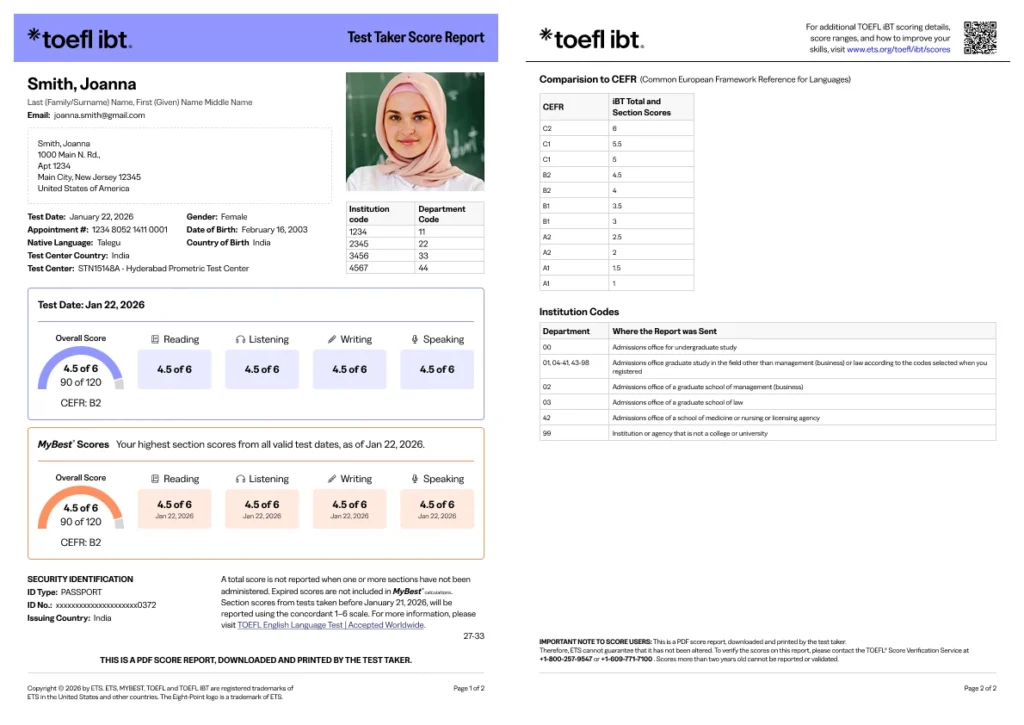
Once your scores are released, you’ll receive an updated, easy-to-read score report through your ETS account. The new format is designed to be clearer, more organized, and visually user-friendly, making it simple to understand your overall performance and section-wise scores.
You can conveniently download a PDF version of your TOEFL iBT score report for official use, university applications, or personal reference.
The TOEFL iBT test taker score report presents your results in a structured layout, highlighting your total score along with individual section scores for Reading, Listening, Speaking, and Writing.
What Changed in January 2026
Starting January 21, 2026, the TOEFL iBT introduced an updated scoring system designed to better align with the Common European Framework of Reference for Languages (CEFR). The revised score report now uses a 1–6 scale, reported in half-point increments, offering a clearer and more globally comparable representation of English proficiency.
Here’s what this update means for test takers:
This update makes TOEFL score interpretation more transparent and internationally aligned while maintaining consistency for universities worldwide.
TOEFL Score Comparison for Tests Taken Before January 21, 2026
| TOEFL Score Band (1–6) | Reading (0–30) | Listening (0–30) | Speaking (0–30) | Writing (0–30) | Total Score (0–120) |
|---|---|---|---|---|---|
| Band 6 | 29–30 | 28–30 | 28–30 | 29–30 | 114+ |
| Band 5.5 | 27–28 | 26–27 | 27 | 27–28 | 107+ |
| Band 5 | 24–26 | 22–25 | 25–26 | 24–26 | 95+ |
| Band 4.5 | 22–23 | 20–21 | 23–24 | 21–23 | 86+ |
| Band 4 | 18–21 | 17–19 | 20–22 | 17–20 | 72+ |
| Band 3.5 | 12–17 | 13–16 | 18–19 | 15–16 | 58+ |
| Band 3 | 6–11 | 9–12 | 16–17 | 13–14 | 44+ |
| Band 2.5 | 4–5 | 6–8 | 13–15 | 11–12 | 34+ |
| Band 2 | 3 | 4–5 | 10–12 | 7–10 | 24+ |
| Band 1.5 | 2 | 2–3 | 5–9 | 3–6 | 12+ |
| Band 1 | 0–1 | 0–1 | 0–4 | 0–2 | 0+ |
Note: The total TOEFL score is calculated by adding the individual section scores. Different combinations of section scores can result in the same overall total.
The updated 1–6 scoring scale is designed to make score interpretation clearer and more consistent for institutions. It also aligns more closely with students’ previous English learning experiences and international assessment standards, making the results easier to understand and compare.
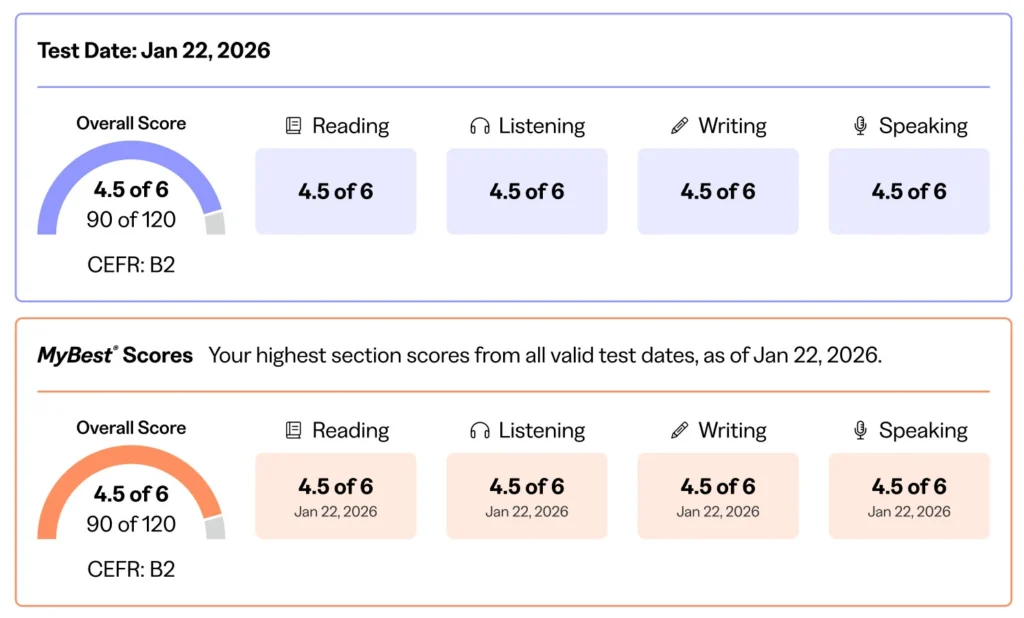
How are MyBest Scores Displayed?
Your score report will include both the scores from the specific test date you choose to send and your MyBest™ scores. This allows institutions to view your highest section scores achieved across valid test attempts, presented clearly within the same report.
Scoring Policies
The scoring process is guided by strict policies established by ETS to ensure fairness, accuracy, and impartial evaluation. Detailed information about these policies is available in the official TOEFL iBT® Information Bulletin (PDF), which outlines how scores are reviewed, validated, and reported.
The TOEFL Exam (Test of English as a Foreign Language) measures academic English skills in reading, listening, speaking, and writing.
TOEFL iBT scores are accepted by universities in the USA, UK, Canada, Australia, and over 160 countries worldwide.
From January 21, 2026, TOEFL iBT uses a 1–6 score scale for each section and overall.
There are four sections: Reading, Listening, Speaking, and Writing.
You can take the TOEFL test multiple times with a minimum gap of three days between attempts.
Your TOEFL iBT scores are typically available within 72 hours (about 3 days) after your test date. You can view and download your scores directly through your ETS account once they are released.
Yes, the TOEFL iBT Home Edition lets you take the test online under secure conditions.
Yes, many study and immigration processes accept TOEFL scores for English proficiency verification.
The Speaking section now includes “Listen & Repeat” and interview-style tasks with updated scoring.
The revised TOEFL iBT is shorter and typically finishes in around two hours.
Yes, every test taker will see pretest questions. These questions are not scored and are used only for research and test development purposes. They are embedded in either the Reading section or the Listening section — not necessarily both.
Time variations occur because pretest questions are included within either the Reading or Listening section. The complete test takes approximately 1 hour and 35 minutes, which also includes administrative steps such as adjusting headphone volume.
The test follows this sequence:
1. Reading
2. Listening
3. Writing
4. Speaking
The updated TOEFL iBT reflects English used in today’s academic settings. Tasks are based on both university coursework and campus life scenarios.
Examples include:
Additionally, the test now includes tasks that assess core language skills, such as Complete the Words, Build a Sentence, and Listen and Repeat.
All test centers worldwide are upgrading to advanced custom “stereophones” developed in partnership with the well-known audio brand Koss Corporation. These headphones are designed to deliver clearer sound quality for Listening and Speaking tasks.
Yes, note-taking is allowed.
The Reading and Listening sections follow a multistage adaptive format.
Test takers complete an initial module in Reading or Listening. Based on their performance, they receive a second module with a difficulty level matched to their ability.
Important points:
Scores are determined by:
Speaking and Writing tasks are assessed using advanced AI scoring systems developed by ETS. These systems use sophisticated Natural Language Processing (NLP) technology. However, human raters remain an essential part of the process. The AI systems are trained on human scoring standards, and human oversight ensures fairness, consistency, and reliability.
Yes, revised performance descriptors aligned with the new 1–6 scoring scale will be published soon on the official TOEFL website to help institutions and test takers better interpret scores.
Registering for the TOEFL Exam is completed entirely online through the official ETS platform. Students can complete the TOEFL exam registration in a few simple steps, and entering correct personal and ID details is essential for a smooth test day.
Collegepond encourages students to register for the TOEFL exam once their study plan is in place. Early TOEFL registration offers better control over test schedules and reduces last-minute pressure. Our counselors help shortlist exam dates that fit application deadlines and score-submission timelines.
Students can also save on TOEFL exam fees by checking available TOEFL discount codes through Collegepond. Eligible students may receive fee support and registration guidance. Visit the Collegepond website to explore current TOEFL discounts and apply with confidence.
ETS provides flexible options to reschedule the TOEFL exam or cancel it if plans change. Understanding the TOEFL rescheduling policy helps students avoid extra charges and last-minute stress.
At Collegepond, we advise students to finalize test dates only after assessing their preparation and readiness. This approach reduces the need for a TOEFL test to reschedule and improves performance confidence.
If your schedule changes, ETS allows you to reschedule TOEFL exam dates online. The process is quick but must be completed within the permitted timeline.
Missing the deadline may result in a loss of the exam fee.
Step-by-Step Process to Reschedule the TOEFL Exam
TOEFL Reschedule Policy 2026
Students are allowed to change their test date under specific conditions.
Key rescheduling rules include:
ETS also allows candidates to cancel their TOEFL exam if they decide not to appear. Cancellations must follow ETS timelines to be eligible for a refund.
Step-by-Step Process to Cancel the TOEFL Exam
TOEFL Exam Cancellation Policy 2026
ETS follows strict rules for TOEFL cancellations.
Important cancellation guidelines:
You can register for the TOEFL iBT test directly through the official ETS portal by creating or logging into your ETS account and selecting your test date, format (test center or Home Edition), and location. Registration is available 24/7 online and must be completed with valid personal details that match your identification exactly.
Yes, TOEFL registration is open throughout the year, and you can book a test slot up to 7 days before the test date via the ETS website. If you book within this period, you may be charged a late registration fee.
When registering, your name and date of birth must match your passport exactly, otherwise you will not be allowed to take the test, and your fee may not be refunded. Also, plan your test at least 2–3 months before your university deadlines to ensure scores are sent on time.
You can register for the TOEFL iBT at a test center or the TOEFL iBT Home Edition. Registration for the Home Edition is done online only, and you must meet system and environment requirements.
You need a valid passport to register and sit for the exam. Make sure your passport is not expired and matches the details you entered during TOEFL registration.
Yes, ETS supports TOEFL registration by phone in many countries. For example, in India you can call the official TOEFL support number (e.g., 1-800-123-9418) to register or get help with booking if online registration isn’t working.
Yes, you can reschedule your test through your ETS account but must do so within the ETS deadlines and may have to pay a rescheduling fee if it’s close to the test date.
For candidates in India, the TOEFL rescheduling fee is approximately ₹5,900 when you change your test date through your ETS account. The change must be made at least four days before your scheduled test date.
If you cancel your TOEFL Exam at least four days before the scheduled test, ETS retains 50% of your exam fee. For a standard TOEFL registration fee of around ₹16,900 in India, this means a cancellation charge of approximately ₹8,450.
Yes — if you request cancellation at least four days before your test date, ETS refunds half of your registration fee. The remaining 50% is retained as the cancellation charge. No refund is provided if the cancellation is made after the deadline.
Preparing well for the TOEFL Exam 2026 is essential to achieve a competitive score for university admissions. Effective TOEFL preparation combines strategy, practice, and familiarity with the TOEFL test structure. With the updated pattern, focused preparation helps you perform confidently across all four sections.
Good TOEFL exam preparation starts early and includes regular evaluation of your strengths and weaknesses. By using proven strategies and guided study workflows, you can improve accuracy and time management on test day.
Top TOEFL preparation tips include:
By following these structured TOEFL preparation tips, students can approach the TOEFL exam confidently and increase their chances of a high score.
Online preparation has become one of the most effective ways to prepare for the TOEFL exam. It offers flexibility, expert guidance, and access to updated study resources. With the right structure, TOEFL preparation online helps students improve their skills consistently and confidently.
Online learning also allows students to track progress and focus on weak areas. This makes the TOEFL exam preparation more personalized and efficient.
Proven Strategies for TOEFL Preparation Online
Start by understanding the exam format and question types. Take a diagnostic test to assess your level, then create a structured study plan covering Reading, Listening, Speaking, and Writing. Use official practice material for realistic TOEFL test preparation and practice under timed conditions regularly.
Yes. Full-length mock tests help improve time management, build stamina, and simulate real exam conditions. They also help identify weak areas so you can adjust your TOEFL preparation strategy accordingly.
Practice answering sample speaking prompts daily and record your responses. Focus on clarity, structure, pronunciation, and time control. Getting feedback from mentors or online tools can significantly improve performance.
Read academic articles and practice skimming for main ideas. Improve vocabulary in context and solve timed reading passages to strengthen comprehension and speed.
Official ETS resources are highly recommended because they reflect the real exam pattern. However, you can also use trusted preparation books and online platforms for additional practice and skill-building.
Avoid studying without a plan, skipping timed practice, ignoring weak sections, and not reviewing mistakes. Consistent practice with proper analysis leads to better TOEFL exam preparation results.
Preparing effectively for the TOEFL iBT exam requires using reliable and official study materials. ETS, the organization behind TOEFL, provides a variety of resources designed to help students understand the test format, practice real questions, and improve their performance. Using official resources ensures that your preparation is aligned with the actual exam standards and question types.
Official TOEFL iBT resources cover all four test sections — Reading, Listening, Speaking, and Writing — and help students develop the skills needed for academic success. These resources are suitable for first-time test-takers, repeat candidates, and anyone aiming to improve their scores.
Key Benefits of Using Official Resources
By relying on official TOEFL iBT resources, students can focus on quality practice rather than using multiple unofficial sources, reducing confusion and increasing confidence on test day.
Collegepond counselors also recommend integrating these resources with a structured preparation plan and mock tests to achieve the best possible scores.
Choosing the right books is a key part of effective TOEFL preparation. Quality preparation books help you understand test formats, practice real-style questions, and build the language skills required for academic success. Below are some of the most trusted TOEFL preparation books that cater to beginners and advanced learners alike.
Published by ETS, this is the most authoritative guide available. It contains real TOEFL questions, detailed explanations, and full-length practice tests. This book helps you understand how sections are scored and what to expect on test day.
Also, from ETS, this set offers multiple full-length practice tests with answer keys. Practicing these tests builds stamina and helps you gauge your readiness before the actual exam.
A comprehensive and user-friendly resource for foundational practice. It includes skill-building exercises for all four sections, practice tests, and vocabulary support. It’s ideal for students who want step-by-step guidance.
This book offers effective strategies, tips, and practice questions designed to boost accuracy and timing. The structured approach helps when you need targeted practice for specific sections such as Speaking and Writing.
Known for its clear explanations and extensive practice material, this book is helpful for strengthening reading skills and academic vocabulary. It also includes sample tests and review exercises.
How These Books Help You Prepare
Video-based learning improves understanding and long-term recall. It is especially effective for students who learn better through visuals and demonstrations.
At Collegepond, video learning is combined with structured TOEFL preparation plans. Our video content is designed around real TOEFL iBT task formats and updated exam trends.
Concept-Focused TOEFL Video Lessons
Strategy and Test-Approach Videos
Live and Recorded Learning Sessions
A TOEFL free practice test helps students understand the real exam format before the actual test day. It simulates the TOEFL iBT experience and highlights strengths and improvement areas.
Taking a free test early supports effective TOEFL exam preparation and goal setting. It also reduces exam anxiety by building familiarity with question types and time limits.
Benefits of taking a TOEFL free practice test:
When should you take the TOEFL free practice test?
A full-length TOEFL test plays a critical role in effective TOEFL exam preparation. It replicates the real TOEFL iBT environment and helps students build stamina and focus.
Regular full-length testing improves confidence, accuracy, and time control. It also prepares students mentally for the actual exam-day experience.
Importance of Full-Length TOEFL Tests
How Many Full-Length Tests to Take
Post-Test Analysis
The most effective TOEFL preparation resources include official ETS materials such as The Official Guide to the TOEFL Test and TOEFL Practice Online, which provide real exam questions and formats.
Other valuable resources include reputable TOEFL prep books (Barron’s, Kaplan, Cambridge), adaptive online platforms with analytics, and video lessons for section-wise skills. Combining official and high-quality third-party resources gives a balanced study approach.
Yes, official ETS resources are highly recommended because they reflect the authentic TOEFL iBT pattern and scoring criteria. ETS materials include real questions, explanations, and full-length tests, helping students familiarize themselves with exam difficulty and format. Many top universities consider performance on ETS-aligned practice more predictive of real test outcomes.
Digital platforms with adaptive practice and analytics are very effective. Examples include ETS TOEFL Practice Online (official), adaptive mock test platforms, and performance dashboards that track progress over time. These tools help simulate real exam conditions and provide insights into weak areas, improving preparation focus.
Yes, Collegepond offers a free TOEFL practice test to help students understand the exam format and assess their current performance level. The test reflects real TOEFL question types and timing, allowing you to identify strengths and improvement areas. It is a useful starting point for structured TOEFL preparation and planning your study strategy effectively.
Choose materials based on your target score, current English level, and preferred learning style. Official ETS materials should form the foundation. Add quality preparation books for depth and use online platforms for timed practice and analytics. Avoid outdated or unofficial sources that don’t match the current TOEFL format.
Practice tests are crucial because they mimic the actual exam format and timing. Regularly taking full-length TOEFL practice tests builds stamina, improves time management, and identifies weak areas. Reviewing mistakes from these tests also helps refine strategies and enhance performance.
Yes, video lessons are useful for concept clarity and skill reinforcement. They work well for visual learners and help explain strategies for Reading, Listening, Speaking, and Writing. Official and expert-led video lessons provide step-by-step guidance that complements book and online practice.
Evaluate resources based on improvement in mock test scores, reduced errors, and increased confidence in each section. Effective resources should provide detailed explanations, real-style questions, and insights into your strengths and weaknesses. Regular progress tracking and analytics help confirm whether your chosen materials are working.