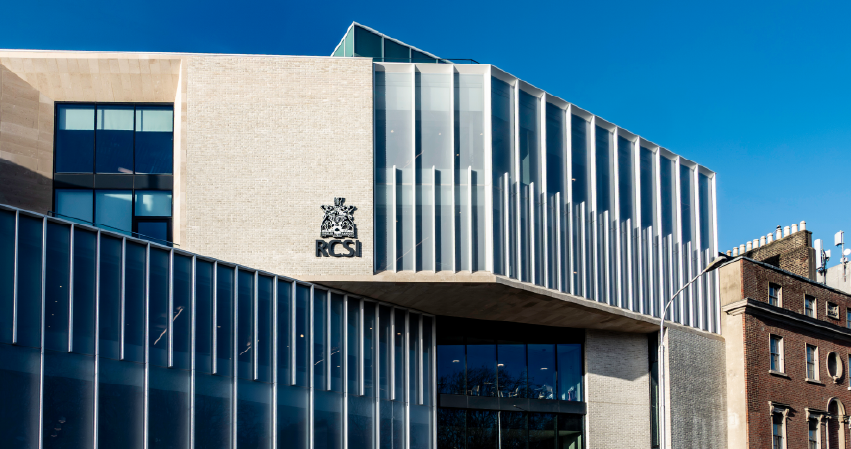
RCSI – the Royal College of Surgeons in Ireland, now RCSI University of Medicine and Health Sciences – is a world-leading, health-sciences-focused university in central Dublin. Founded in 1784 by Royal Charter as Ireland’s national training body for surgery, it gained independent degree-awarding status in 2010 and full university status in 2019, while continuing its historic role in Irish surgical training.
Royal College of Surgeons in Ireland (RCSI) is exclusively focused on medicine and the health sciences, with schools of Medicine, Pharmacy & Biomolecular Sciences, Physiotherapy, Nursing & Midwifery, Population Health, and postgraduate faculties in surgery, dentistry, and radiology. Its main campus sits on St Stephen’s Green and York Street, with Beaumont Hospital as its principal teaching hospital alongside other leading Dublin hospitals.
Genuinely international, Royal College of Surgeons in Ireland (RCSI) has campuses and partnerships in Bahrain, Dubai, and Malaysia, with more than 60 nationalities on campus and a global network of over 30,000 graduates across 90+ countries. It was ranked first in the world for SDG3 ‘Good Health and Well-being’ in the Times Higher Education Impact Rankings 2025 and is home to one of Europe’s largest clinical simulation facilities.
Table of Contents
Key Stats at a Glance
| Parameter | Detail |
|---|---|
| Institution | RCSI – Royal College of Surgeons in Ireland / RCSI University of Medicine and Health Sciences (founded 1784) |
| Type | Not-for-profit, health-sciences-focused university |
| Location | St Stephen’s Green and York Street, Dublin 2 (city centre) |
| Schools | Medicine; Pharmacy & Biomolecular Sciences; Physiotherapy; Nursing & Midwifery; Population Health; plus postgraduate surgery, dentistry & radiology |
| Global recognition | No. 1 in the world for SDG3 Good Health & Well-being (THE Impact Rankings 2025); top-decile field-weighted citation impact |
| International reach | Campuses/partnerships in Bahrain, Dubai, and Malaysia; 60+ nationalities on campus |
| Alumni | 30,000+ graduates across 90+ countries |
| Teaching hospitals | Beaumont (principal), Connolly Blanchardstown, Royal Victoria Eye & Ear, University Hospital Waterford |
| Facilities | RCSI SIM – one of Europe’s largest clinical simulation centres |
| Medium of instruction | English |
Note: Rankings and figures vary by source and year. Confirm current details on the official RCSI site (rcsi.com).
Programs (Courses & Schools)
Royal College of Surgeons in Ireland (RCSI) focuses exclusively on medicine and the health sciences, at undergraduate and postgraduate level:
| Area | Examples |
|---|---|
| Medicine | Undergraduate Medicine (six-year and five-year routes) and the four-year Graduate Entry Medicine (GEM) programme – RCSI was the first in the Republic of Ireland to offer GEM (2006). |
| Pharmacy | Pharmacy and biomolecular sciences – preparing pharmacists and healthcare innovators. |
| Physiotherapy | Undergraduate physiotherapy with strong clinical placement. |
| Postgraduate & research | MSc, MD, and PhD across surgery, radiology, nursing & midwifery, healthcare leadership, and translational research (cancer, neuroscience, population health, surgical science, regenerative medicine). |
All teaching is supported by RCSI SIM, one of Europe’s largest clinical simulation facilities. See the full, current course list on the official site.

Fees (International Students)
As a specialist medical university, RCSI’s fees – particularly for Medicine – are among the highest in Ireland. The figures below are broad indicative ranges; you must confirm exact fees for your programme and year on the official site.
| Programme (international) | Indicative Tuition / year |
|---|---|
| Medicine (undergraduate / GEM) | Very high – broadly ~€45,000–€60,000 (among the highest in Ireland) |
| Pharmacy / Physiotherapy | Lower – broadly ~€20,000+ (varies) |
A deposit is payable to accept your offer. Dublin living costs are higher than elsewhere in Ireland – budget roughly €13,000–€16,000 per year. Because medicine is a major financial commitment, confirm the exact tuition, duration, and total cost directly with RCSI before applying.
Admission Process & Timeline
International (non-EU) students apply directly to RCSI. The general steps are:
- Choose your programme and check its specific entry requirements (including age – you must be 18 by 31 December of the year of entry for medicine).
- Apply through RCSI’s online application system (Irish/EU applicants apply via the CAO) and pay the ~€75 application fee.
- Submit academic transcripts, English-language evidence, and a personal statement; sit any required tests – the Casper situational judgement test for five- and six-year medicine, and the HPAT for Irish/EU applicants.
- Some applicants attend an interview; you then receive a conditional or unconditional offer.
- Accept your offer, pay the deposit, and arrange your study visa and accommodation.
Medicine is highly competitive (around a 45% acceptance rate), with the main intake in September. Apply early to allow time for tests, the offer, and your visa.
Curious about other top universities in Ireland? Explore our complete Study in Ireland guide to compare options.
Scholarships & Financial Planning
Given the cost of medical study, plan your finances carefully. Support options include:
- RCSI scholarships and awards — a limited number of merit-based awards (these vary by year and programme).
- Government of Ireland International Education Scholarships — competitive national awards open to international students.
- Education loans and instalment options — commonly used by international (including Indian) students to fund medical study.
Scholarships rarely cover the full cost of medicine, so budget for tuition plus living costs. Check the official RCSI fees and scholarships pages for current details.
Admission / Entry Requirements (Academic & English)
- Undergraduate Medicine: Strong school-leaving results (for example, excellent Class 12 / equivalent with the required science subjects); the Casper situational judgement test is required for five- and six-year programmes.
- Graduate Entry Medicine (GEM): A recognised bachelor’s degree (often in a science discipline) with strong results.
- Pharmacy / Physiotherapy: Strong school-leaving results with the required science subjects.
- English proficiency: Typically IELTS 6.5 overall with no band below 6.0 (some programmes require higher); TOEFL and PTE are also accepted.
Requirements are detailed and programme-specific – always check the individual course page on the official site.

Notable Alumni
Across more than two centuries, Royal College of Surgeons in Ireland (RCSI) has educated distinguished clinicians, scientists, and leaders worldwide. Notable graduates include:
| Name | Known for |
|---|---|
| Wan Azizah Wan Ismail | Malaysia’s first female Deputy Prime Minister and a medical doctor; an RCSI medicine graduate. |
| Professor Ara Darzi (Lord Darzi) | World-renowned surgeon, professor at Imperial College London, and former UK health minister; an RCSI medicine graduate. |
| Oliver St John Gogarty | Surgeon, poet, and writer – a celebrated figure of early-20th-century Dublin; an RCSI graduate. |
| Abraham Colles | Pioneering surgeon and anatomist who first described the “Colles’ fracture”; closely associated with RCSI. |
RCSI’s graduates lead in surgery, medicine, pharmacy, and health research in hospitals and universities across Ireland, the UK, North America, the Middle East, and Asia.
Campus Life
RCSI’s campus sits in the heart of Dublin on St Stephen’s Green – a historic, central location surrounded by the city’s cultural life and close to its leading teaching hospitals. Despite its specialist focus, Royal College of Surgeons in Ireland (RCSI) offers a full and supportive student experience.
Highlights of the student experience include:
- A close, international community with more than 60 nationalities and a strong tradition of student clubs and societies.
- World-class facilities, including the RCSI SIM clinical simulation centre and a modern health-sciences library.
- Cultural and social events – from international food and music nights to outdoor and sporting activities.
- Dedicated support for international students, including orientation, welfare, and careers services.
Royal College of Surgeons in Ireland (RCSI) does not have large on-campus housing; students live in private accommodation across central Dublin – arrange housing early, as Dublin is competitive.
Careers & Employability
Royal College of Surgeons in Ireland (RCSI) prepares graduates for healthcare careers that cross national boundaries:
- Medical graduates progress into internship training in Ireland and into residency/specialty training across the UK, North America, the Middle East, and Asia.
- Pharmacy, physiotherapy, and health-sciences graduates work in clinical practice, the (bio)pharmaceutical industry, research, and healthcare management.
- RCSI’s internationally recognised qualifications and global alumni network support careers and electives worldwide.
- Ireland’s Third Level Graduate Programme lets eligible non-EU graduates stay to seek work — typically up to 1 year after a Level 8 (honours) degree and up to 2 years after a Level 9 (master’s), subject to current rules; medical interns follow separate registration pathways.
Post-study work and medical-registration rules are set by Irish authorities and can change – verify the latest requirements on official sources.

FAQs
On St Stephen's Green and York Street in central Dublin, Ireland, with affiliated teaching hospitals across the city.
Medicine and the health sciences - it is Ireland's historic surgical training body and a world-leading health-sciences university, ranked No. 1 globally for SDG3 Good Health & Well-being (THE Impact Rankings 2025).
Undergraduate Medicine (including the four-year Graduate Entry Medicine programme), Pharmacy, and Physiotherapy, plus postgraduate and research degrees across surgery, radiology, nursing, and health sciences.
Medicine fees are among the highest in Ireland (broadly in the region of €45,000–€60,000 per year for non-EU students); pharmacy and physiotherapy are lower. Confirm exact fees with Royal College of Surgeons in Ireland (RCSI), and budget €13,000–€16,000 for Dublin living costs.
The Casper situational judgement test is required for the five- and six-year medicine programmes (Irish/EU applicants also sit the HPAT). Requirements vary - check the official site.
Typically IELTS 6.5 overall with no band below 6.0 (some programmes require higher); TOEFL and PTE are also accepted.
Non-EU students apply directly through RCSI's online system (Irish/EU applicants via the CAO), with a ~€75 application fee.
The main intake is September; medicine is highly competitive, so apply early.
Eligible non-EU graduates may use Ireland's Third Level Graduate Programme to seek work; medical graduates follow internship and registration pathways set by Irish authorities. Rules can change - verify current details.
Royal College of Surgeons in Ireland (RCSI) offers a globally recognised, specialist health-sciences education with a 240-year heritage, world-class simulation facilities, strong clinical training, and an international alumni network.
Ireland Universities
- Trinity College Dublin (TCD)
- University College Dublin (UCD)
- University of Galway
- University College Cork (UCC)
- National College of Ireland (NCI)
- Dublin City University (DCU)
- University of Limerick (UL)
- Technological University of the Shannon
- Dublin Business School (DBS)
- Griffith College Dublin
- Technological University Dublin
- Munster Technological University (MTU)
- Atlantic Technological University (ATU)
- Dundalk Institute of Technology (DkIT)
- National College of Art and Design
- Institute of Art, Design & Technology
- Mary Immaculate College (MIC)
- Maynooth University
- Royal College of Surgeons (RCSI)
- South East Technological University
- Shannon College of Hotel Management
- Independent College Dublin
- ICD Business School
- Dorset College Dublin
- CCT College Dublin
- American College Dublin
Ireland Universities

-
National College of IrelandApp Fee Waiver
-
Dublin City UniversityApp Fee Waiver
-
Dublin Business SchoolApp Fee Waiver
-
University College DublinApp Fee Waiver*€70 for 4 programs still applicable.
-
Dundalk Institute of TechnologyApp Fee Waiver
-
South East Technological University, CarlowApp Fee Waiver
-
Griffith College – Dublin, Cork & LimerickApp Fee Waiver
-
Munster Technological University (CIT)App Fee Waiver
-
Technological University Shannon (Athlone & Limerick)App Fee Waiver