Studying abroad is a big investment, and one of the most important questions students ask is:
“Will my master’s degree be worth the money?”
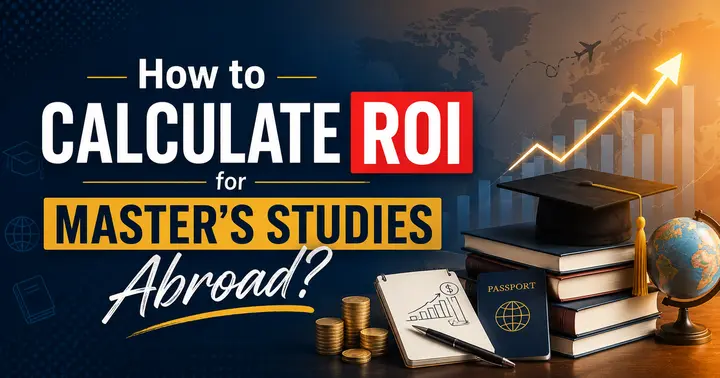
This is where ROI (Return on Investment) becomes important. ROI helps students understand whether the money spent on tuition fees, living expenses, and other costs can be recovered through future salary and career growth.
What Is ROI in Study Abroad?
ROI simply means: How much benefit you receive compared to how much money you spend.
For master’s studies, ROI is usually calculated by comparing:
- Total cost of education
- Expected salary after graduation
Time required to recover the investment
Step-by-Step ROI Calculation
Step 1: Calculate Total Cost of Education
Include all expenses such as:
- Tuition fees
- Accommodation
- Food and transport
- Health insurance
- Visa and flight tickets
- Miscellaneous expenses
Example:
| Expense | Amount |
|---|---|
| Tuition Fees | ₹25 Lakhs |
| Living Expenses | ₹10 Lakhs |
| Other Costs | ₹5 Lakhs |
| Total Investment | ₹40 Lakhs |
Step 2: Estimate Your Expected Salary / Expected Savings
Research the average salary after graduation in your chosen country and field.
Example:
- Expected Salary After MS = ₹60 Lakhs per year
Check out the income tax rate of the country. It can vary from negligible (UAE) to very high (more than 50% in some European countries).
Assume:
- 20% tax
- 50% expenses (food, accommodation, transport)
- 10% emergency funds, travel, miscellaneous expenses
Savings of about 20% = ₹12 Lakhs per year
Step 3: Understand Payback Period
The payback period means:
“How long will it take to recover your investment?”
If you save ₹12 Lakhs per year after expenses, you may recover your education cost of ₹40 Lakhs in about 5 years.
Why is it not a straight 3.5 years? You need to assume that the ₹40L also incurs an interest component — either if you’re taking a loan (interest on the loan) or if you had invested that money in an FD, you would have made some interest on it.
Assuming 10% interest component: We add about ₹4 Lakhs/year, which means ₹20 Lakhs extra for 5 years.
Thus, if we’re saving ₹12 Lakhs per year, it will take 5 years to recover ₹60 Lakhs (₹40 Lakhs investment + ₹20 Lakhs interest).

What Is a Good Time for ROI?
If you recover the money between 3 to 5 years, it’s a good ROI.
Note: In the above example, if the student got a scholarship, worked on campus, or got an RA/TA, the actual cost can come down and the time to recover (or ROI) becomes less.
Is This the Best Way to Calculate ROI?
What we spoke about above was the quantifiable ROI part. However, there are elements that can’t be quantified:
- The exposure you get
- The brand recognition (sometimes a brand may also have a higher price tag)
- The cohorts and peers you meet
Another analogy: If I wish to buy a car in India, a Maruti or Tata car can be a better ROI as I spend much less than a BMW or Mercedes (where the quantifiable parameter changes as the cost triples). But then the class, luxury, brand — if that is taken into account — those are non-quantifiable ROI components.
Other Non-Quantifiable Factors
- Countries offer different salary levels and tuition costs.
- Top-ranked universities usually provide better placement opportunities and networking.
- Programs like Data Science, AI, Finance, Engineering, and Business Analytics often offer higher salaries than, say, Psychology or Architecture
- Post-study work permits and internship opportunities also impact ROI greatly.
- Scholarships can significantly reduce investment and improve ROI.
Some popular high-ROI programs include:
- Computer Science
- Data Science
- Artificial Intelligence
- Cybersecurity
- Finance
- Business Analytics
- Engineering Management
Final Thoughts
ROI should not be calculated only in terms of salary. A master’s degree abroad also provides:
- Global exposure
- International career opportunities
- Better networking
- Long-term career growth
- Personal development
A smart study abroad decision is not about choosing the cheapest university — it is about choosing the option that gives the best value for your future.